


By Move2Bohol Staff
Picture this: a 38-year-old systems engineer from Shinjuku. She’s been with the same company for eleven years. She has a tidy 25-square-meter apartment she rarely relaxes in, a commute she’s stopped counting, and a salary that looks respectable on paper but evaporates before the 20th of every month. The groceries are more expensive than they were last year. The rent just went up again. And somewhere in the back of her mind, a thought she can’t quite shake: there has to be another way to live.
She’s not alone. In fact, she’s part of a quietly growing wave.
Across Japan — in the cramped efficiency apartments of Shibuya, the corporate dormitories of Osaka, the overtime-heavy office culture of Tokyo’s 23 wards — single Japanese men and women in their 30s, 40s, and early 50s are beginning to ask the same question with increasing urgency: what if the life I’m working myself to the bone for is available somewhere else, for a fraction of the cost, with actual daylight and breathing room attached?
For a growing number of them, the answer is pointing southeast. And increasingly, past Bali, past Chiang Mai, toward a quieter island that most of the world hasn’t fully discovered yet: Bohol, Philippines.
The Breaking Point That’s Driving the Departure
Japan’s rising cost of living is no longer a background concern. It has become a front-page reality.
In 2025, a record 20,609 food items saw price increases — 64.6% more items than the year before. By late 2025, monthly household food expenses for an average family had climbed to the ¥90,000–¥94,000 range, up from around ¥70,000 just a year or two prior. Electricity and gas bills also spiked due to rising energy costs.
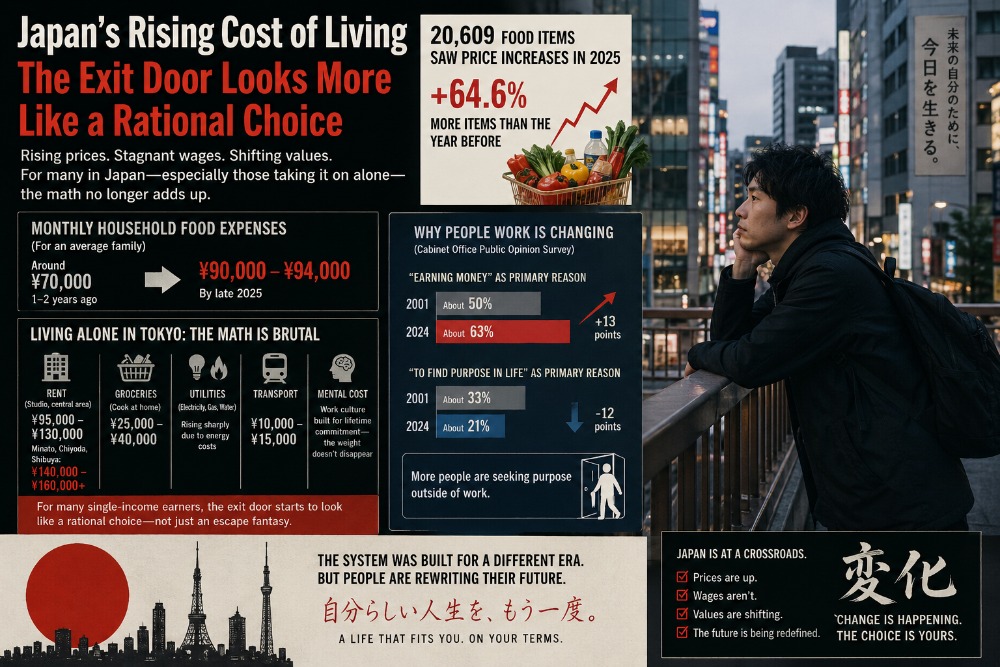
For single people in Tokyo — who are absorbing all of these costs on a single income with no shared household economies — the math has become brutal. A studio apartment in a reasonably central location now averages ¥95,000–¥130,000 per month, with central wards like Minato, Chiyoda, and Shibuya pushing well past ¥140,000–¥160,000. Add groceries at ¥25,000–¥40,000 a month for someone who cooks at home, utilities, transport, and the psychological weight of a work culture that has not yet fully shaken its identity as a system built for lifetime commitment — and the exit door begins to look more and more like a rational choice rather than an escape fantasy.
The meaning of work in Japan is also changing. According to a Cabinet Office public opinion survey, the share of people who cite “earning money” as their primary reason for working rose from roughly 50% in 2001 to approximately 63% in 2024. By contrast, those who say they work “to find purpose in life” has declined — indicating that more people are seeking that sense of purpose outside of work entirely.
That search for purpose — combined with genuine financial pressure — is sending a new kind of Japanese relocator into Southeast Asia. Not the tourist. Not the brief sabbatical-taker. The person quietly building a plan for a different life.
Why Southeast Asia — And Why Now?
The trend of Japanese early retirees and remote professionals looking abroad is not new. What is new is the scale, the demographic, and the destination calculus.
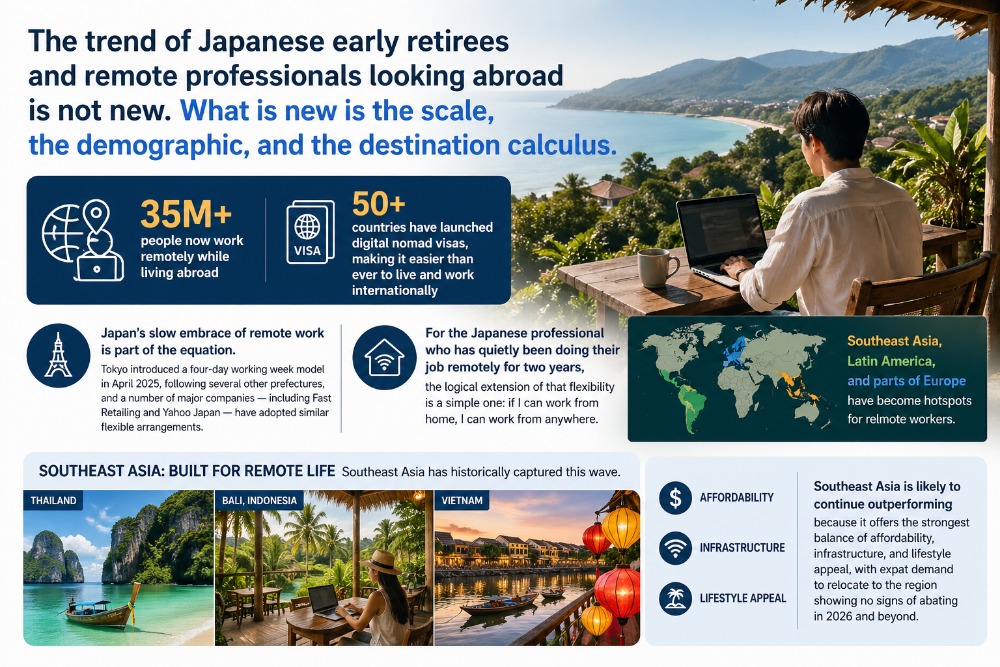
More than 35 million people now work remotely while living abroad, and over 50 countries have launched digital nomad visas, making it dramatically easier to live and work internationally. Southeast Asia, Latin America, and parts of Europe have become hotspots for remote workers.
Japan’s own slow embrace of remote work is part of the equation. Tokyo introduced a four-day working week model in April 2025, following several other prefectures, and a number of major companies — including Fast Retailing and Yahoo Japan — have adopted similar flexible arrangements. For the Japanese professional who has quietly been doing their job remotely for two years, the logical extension of that flexibility is a simple one: if I can work from home, I can work from anywhere.
Southeast Asia has historically captured this wave. Thailand, Bali, and Vietnam have all built robust expat ecosystems over the past decade. Southeast Asia is likely to continue outperforming because it offers the strongest balance of affordability, infrastructure, and lifestyle appeal, with expat demand to relocate to the region showing no signs of abating in 2026 and beyond.
But here is where the story gets more interesting — and where Bohol enters the picture.
Bali Is Crowded. Chiang Mai Has Changed. Bohol Is Different.
Let’s be honest about what has happened to the two most famous expat destinations in Southeast Asia over the past decade.
Bali was once an affordable paradise. Today, it is crowded, commercialized, and in parts deeply overwhelmed by its own popularity. Visa restrictions have tightened. Rent in Canggu and Seminyak has crept toward uncomfortable levels. The “authentic Bali” that drew the first wave of expats barely exists in its original form in the places where most foreigners congregate.

Chiang Mai remains genuinely affordable and has a strong digital nomad infrastructure. But for a single Japanese professional seeking something beyond a co-working café and a well-worn expat trail, it can feel familiar to the point of predictability — a Southeast Asian lifestyle packaged for Western consumption.
Bohol offers something structurally different. It is not yet packaged. It is not yet crowded. And for the single Japanese person willing to arrive slightly ahead of the crowd, that matters enormously.
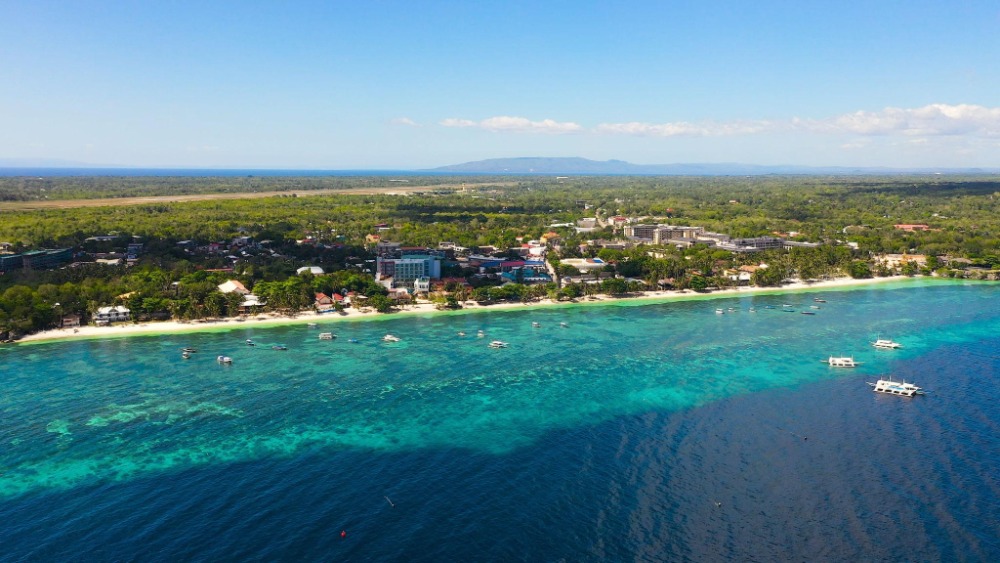
Smaller cities and island communities tend to hold long-term residents longer than capital hubs. Daily life runs more smoothly. Distances are shorter. Community forms without constant effort. Bohol is a textbook example of this dynamic. Tagbilaran City — the provincial capital — has the services and infrastructure a single relocator needs without the noise and density of a metropolis. Panglao Island, just across the bridge, offers world-class beaches, diving, and a pace of life that no amount of money purchases in central Tokyo.
And crucially, for a Japanese resident accustomed to a culture that prizes cleanliness, order, natural beauty, and quiet — Bohol’s character is not as foreign as the geography might suggest.
The Numbers That Stop People in Their Tracks

Let’s put the comparison on paper, because the numbers are stark enough to change a decision.
A modest single-person life in Tokyo (2026):
A studio apartment in a non-central ward runs ¥80,000–¥100,000 per month. Utilities add another ¥15,000–¥25,000 in an average month — more in summer and winter. Groceries for a single person who cooks regularly cost ¥35,000–¥55,000. Transport, even using a commuter pass, adds ¥10,000–¥15,000. Mobile, internet, and incidentals bring the total to somewhere between ¥160,000 and ¥220,000 per month — and that is a deliberately frugal life in a less expensive neighborhood. A comfortable lifestyle in Tokyo runs ¥200,000–¥260,000 per month for a single person. And none of that includes the substantial move-in costs — you should budget three to five months’ rent worth of cash to cover all initial costs when securing a Tokyo apartment.
A comfortable single-person life in Bohol (2026):
A modern, fully furnished one-bedroom apartment in Tagbilaran City runs ₱20,000–₱30,000 per month — roughly $360–$540. Utilities for a single expat average ₱6,000–₱10,000 monthly. Fresh fruits, vegetables, rice, and fish from local markets are extremely affordable. A comfortable lifestyle in a provincial setting like Bohol typically costs ₱60,000–₱90,000 per month — approximately $1,000 to $1,600.
At today’s exchange rates, ¥160,000 — a modest Tokyo month — translates to roughly $1,000. In Bohol, that same $1,000 is not a survival budget. It is a genuinely comfortable life, with good food, beachfront access, and the kind of space that Tokyo’s price-per-square-meter makes a luxury rather than a baseline.
For a single Japanese professional earning ¥300,000 a month remotely — a solidly middle-class Tokyo income — relocating to Bohol does not just mean reduced stress. It means the structural ability to save money, build a cushion, and live in a way that Tokyo’s cost-of-living arithmetic makes nearly impossible.
The Cultural Adjustment: Closer Than You Might Expect

The most common hesitation Japanese relocators express is cultural: will I adapt? Will I be accepted? Will everyday life feel manageable or alienating?
The honest answer, for Bohol specifically, is more reassuring than most people expect.
The Philippines and Japan share a longer cultural thread than geography suggests. Both societies place genuine value on hospitality, on respect for elders, on collective community identity, and on the kind of quiet social warmth that doesn’t require loud declaration. The Filipino term bayanihan — community cooperation, looking after one’s neighbors — resonates with values deeply familiar to the Japanese resident who has lived their whole life in a culture that prizes the collective alongside the individual.
English is widely spoken across Bohol, which removes the immediate language barrier that makes daily logistics so exhausting in non-English-speaking destinations. Navigating a Tagbilaran market, dealing with a landlord, or setting up a local bank account does not require a translation app at every step. For the Japanese professional accustomed to the meticulous systems of Tokyo, this accessibility matters.
The food transition deserves special mention. Filipino cuisine shares an Asian pantry in many respects — rice as the staple, fresh fish and seafood central to the daily diet, a culture of clean, home-cooked meals. Japanese ingredients are increasingly available in larger Cebu City (a 30-minute ferry from Bohol), and the sensory environment of Bohol’s local markets — fresh, fragrant, and quietly organized — will feel familiar to anyone who has spent a morning at a neighborhood Japanese wet market.
The adjustment that does require patience is pace. The Filipino relationship with time, logistics, and the phrase “later” (mamaya) operates differently from the clockwork precision of Japanese daily infrastructure. The tricycle arrives when it arrives. The internet installer comes the day after the day after the agreed day. For a personality shaped by the exactness of Tokyo’s train system, this is the real cultural recalibration — and according to long-term Japanese residents across the Visayas, it is also, ultimately, the most liberating one. The urgency falls away. The day opens up. And the question of what am I rushing toward, exactly? — the question Tokyo never quite gives you space to ask — finally gets answered.
What Bohol Specifically Offers the Single Japanese Relocator
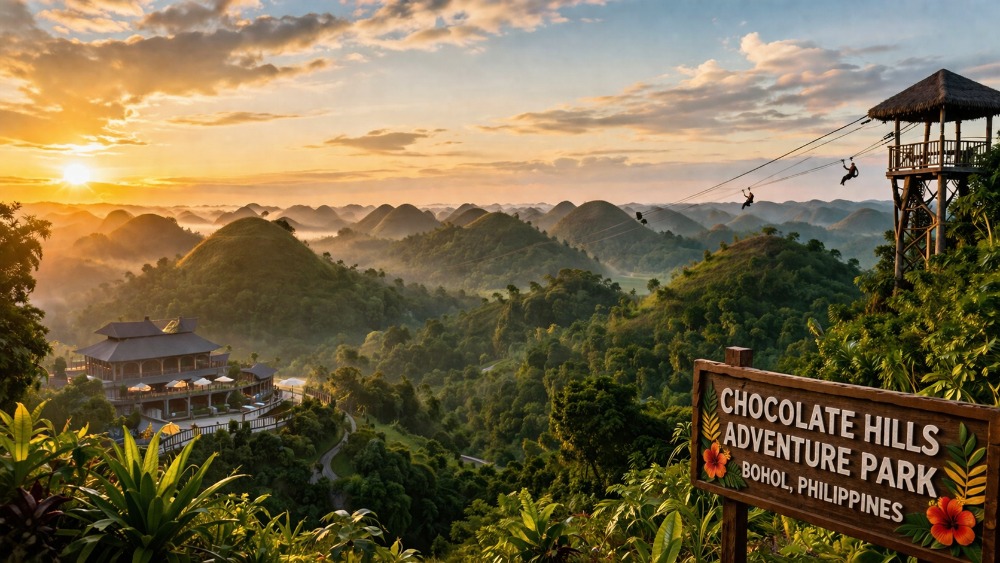
Beyond cost and culture, Bohol offers a set of practical advantages that deserve their own inventory.
Safety. Bohol consistently ranks among the safer provinces in the Philippines. For a single woman or man arriving alone, the social fabric of a small island community provides a natural safety net that an anonymous city never can. Neighbors know neighbors. Faces become familiar quickly. The anonymity that makes large cities feel dangerous does not exist here in the same way.
Natural beauty as a daily reality. The Chocolate Hills. The Loboc River. Panglao’s white sand beaches. The world-class dive sites of Balicasag. These are not weekend destinations from Bohol — they are the landscape of an ordinary Tuesday. For the Japanese professional whose relationship with nature has been limited to parks and planned holiday excursions, this daily proximity to genuine natural wonder is not a small thing. It reshapes the texture of a life.
A community being actively built. This is where Move2Bohol and the broader Coconuts ecosystem offer something that most relocation destinations don’t: a community with a mission at its center. The Bohol Coconuts Baseball & Softball Club and its surrounding ecosystem — including the Eco-Lodge Suites, the Founders Club, and the Building the Coconuts YouTube docuseries launching May 25 — provide a ready-made social and purpose-driven infrastructure for the arriving expat who wants more than a beautiful view and a lower rent. It is, as the Tropical Relocation Club puts it, not escape for a week. It is reinvention for the next chapter.
Proximity to Japan. Bohol is accessible from Tokyo, Osaka, and Nagoya with a single connection through Cebu or Manila — a manageable travel day, not a transcontinental ordeal. Maintaining ties to family, navigating periodic returns to Japan for business or personal reasons, and keeping one foot in both worlds is logistically realistic in a way that relocation to Latin America or Europe is not.
The Practical Starting Point
For the single Japanese professional reading this and feeling the pull of recognition — here is what the first steps actually look like.
Japanese nationals can enter the Philippines visa-free for 30 days, extendable through the Bureau of Immigration for up to 36 months without leaving the country. The SRRV (Special Resident Retiree’s Visa) provides a more structured long-term pathway, requiring a deposit with the Philippine Retirement Authority — refundable upon surrender — along with proof of pension or income. For those not yet at retirement age, tourist visa extensions combined with remote income represent the most common initial arrangement.
Move2Bohol’s Visa & Legal Assistance service exists precisely to navigate this process without the confusion that comes from reading three contradictory blog posts and hoping for the best. The same applies to Property Solutions and Lifestyle Integration — services designed for people who are serious about the move, not still shopping the idea.
The Bohol Island: A Complete Foreigner’s Handbook and The $15K Island Lifestyle e-books available through Move2Bohol give the kind of grounded, practical detail that makes the difference between a dream and a plan.
The Question Worth Sitting With
The systems engineer from Shinjuku we met at the beginning of this article is a composite — but she is not a fiction. She represents tens of thousands of single Japanese professionals in their 30s and 40s who are quietly running a calculation in the background of their lives, comparing what they have against what they could have, and wondering if the courage required to make a change is actually greater than the courage required to stay.

Most indicators suggest that the migration trend toward more affordable, livable, community-grounded destinations is structural — not a short-lived response to recent pressures, but a meaningful, sustained shift in how people think about where and how they want to live.
Bohol won’t be undiscovered forever. The infrastructure is growing, the expat community is forming, and the window for arriving ahead of the crowd is open — but windows don’t stay open indefinitely.
The apartment in Tokyo will still be there. The island, the air, the ocean, the pace, the space, and the life that costs half as much and delivers twice as much room to breathe — those are available right now, for whoever decides they’re ready to trade pressure for purpose.
Join the Tropical Relocation Club to connect with a community of like-minded people already building this life. Download the Ownership Packet for a deeper look at what the Bohol opportunity actually includes. And when you’re ready to stop browsing and start building — Move2Bohol is where the plan begins.