
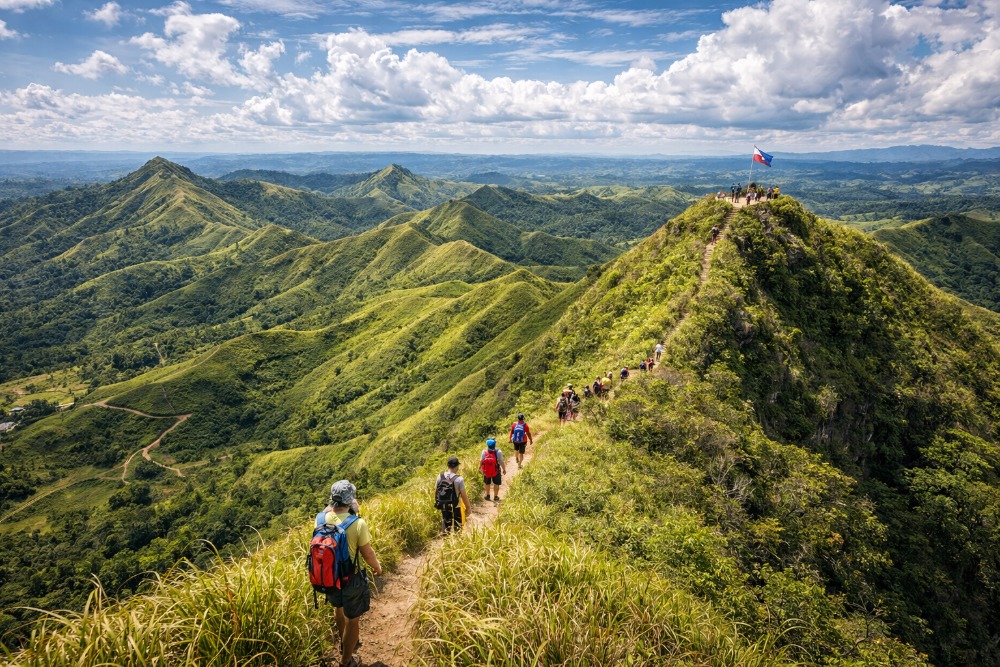
A Preview of the Places Where the Story Unfolds
Building the Coconuts is not a studio production. Every location you will see in the series is real, every road connecting those locations is one the production team travels regularly, and every community that appears on screen is one whose people have a relationship with this project.
Bohol is a small island by Philippine standards but a remarkably layered one. Within a radius of roughly 25 kilometers from Barangay Cambanac, where the Coconuts Performance Center is being built, you will find colonial-era stone churches, the world’s smallest primate in a protected forest sanctuary, one of the most recognized rivers in the archipelago, and a beach destination that draws international divers from every continent.
The series moves through all of it.
Here is a preview of the places where this story unfolds.
Baclayon: Where It All Begins
The Coconuts Performance Center is being built in Barangay Cambanac, which sits within the municipality of Baclayon, the oldest Spanish-established municipality on Bohol Island.
Founded in 1595 by two Jesuit priests who arrived to begin the conversion of the local population, Baclayon once encompassed the territory that now includes Corella, Sikatuna, Alburquerque, and even a portion of what became Tagbilaran City. The Baclayon Church of the Immaculate Conception, built from coral stone and now designated a National Cultural Treasure, still stands at the town’s center as one of the oldest stone churches in the country.
For viewers, Baclayon is the home base of the series. Every supply run, every community meeting, every early morning on the construction site happens here.
Tagbilaran City: The Capital and the Crossroads
Six kilometers west of Baclayon along the coastal road sits Tagbilaran City, the capital of Bohol province and the island’s principal point of entry. The city is where ferries from Cebu arrive, where most supplies for the project are sourced, where hospital visits happen, where government offices are located, and where the production team passes through more times than they can count.
With a population of just under 105,000 as of the 2020 census and roughly 13 kilometers of coastline on Bohol’s southwestern shore, Tagbilaran is a working city rather than a tourist destination. It is the place where Bohol conducts its daily business. You will see it in the background of the series more often than you will see it featured, which is appropriate. It is part of the infrastructure that makes everything else possible.
Panglao and Dauis: The Island Next Door
Connected to the Bohol mainland by two causeways, Panglao Island is the province’s most internationally recognized destination. Its white sand beaches, clear water, and world-class dive sites have drawn visitors from Japan, Europe, Australia, and North America for decades. Bohol-Panglao International Airport, which opened in 2018 to replace the old Tagbilaran airfield, sits on the island’s western edge and serves as the entry point for most visitors arriving by air.
The island contains two municipalities. Dauis occupies the eastern portion closest to the mainland causeways and has its own historic church dating to the Spanish period. Panglao town covers the western portion of the island, though most resort development and beach activity is concentrated along Alona Beach on the southwestern coast.
For the series, Panglao and Dauis represent the world that exists just minutes from Cambanac, a world most of the barangay’s children have seen but few have had a structured reason to engage with. That contrast is part of the story.
Loay and Loboc: Into the Interior
Follow the river road inland from the coast and within 20 to 25 kilometers you reach the municipalities of Loay and Loboc, where Bohol’s interior begins to assert itself and the landscape shifts from coastal flatlands into forested hills. The Loboc River, one of the most photographed rivers in the Philippines, winds through jungle that closes over the water on both sides. The floating restaurant cruises that operate on its surface have become a signature Bohol experience for visitors from around the world, and the Loboc Children’s Choir, one of the most decorated youth performance groups in Southeast Asia, rehearses here.
The river and the towns along it represent the kind of cultural wealth that exists throughout Bohol’s interior and that rarely registers in the lives of children growing up in communities like Cambanac without a club or an organization to make those connections visible.
Corella and Sikatuna: The Forest Towns
Northeast of Tagbilaran City, the municipalities of Corella and Sikatuna sit in hillier terrain where the island’s forest cover is denser and where some of Bohol’s most significant conservation work is concentrated.
The Philippine Tarsier and Wildlife Sanctuary in Corella, managed by the Philippine Tarsier Foundation across a 134-hectare forest reserve, is the most ethically responsible place in the Philippines to observe the world’s smallest primate in something close to its natural habitat. The sanctuary has become a landmark of Bohol’s broader identity as an island that takes its biodiversity seriously. Holy Name University, which formally adopted Barangay Cambanac earlier in 2026 to provide monthly health and livelihood services to residents, has conducted previous community programs in Corella as well, creating an unexpected thread connecting these two communities.
Sikatuna takes its name from Datu Sikatuna, the local chieftain who conducted the blood compact with Spanish conquistador Miguel Lopez de Legazpi in 1565, one of the most symbolically significant moments in Philippine colonial history. That compact was sealed not far from the shores of what is now Tagbilaran. The municipality that carries his name sits quietly in Bohol’s hills, a reminder that history is never far from the surface on this island.
Alburquerque: The Gateway to the Hills
South of Corella and east of Tagbilaran, the municipality of Alburquerque sits along routes that connect the coastal communities to Bohol’s interior highlands. It is one of the municipalities that was once part of the original Baclayon territory before being established as a separate entity, and its landscape captures the transitional quality of this part of Bohol: neither fully coastal nor fully interior, sitting at the point where the island begins to fold into itself.
The roads through Alburquerque are ones the production team travels when moving between the coast and the highland construction site, and the municipality will appear in the series the way most of these communities do: not as a featured destination, but as part of the living geography that surrounds and supports the central story.
What These Places Add Up To
Viewed together, these locations tell you something important about where Building the Coconuts takes place. This is not a story set in an anonymous tropical landscape. It is set in a specific, historically layered, ecologically remarkable island that has been shaped by four centuries of colonial influence, by its own indigenous traditions, by international tourism, and by the quiet daily life of communities like Cambanac that exist at the intersection of all of it.
When you watch the series, you are watching something being built in a place that already has a story. The Bohol Coconuts is adding a new chapter to it.
