

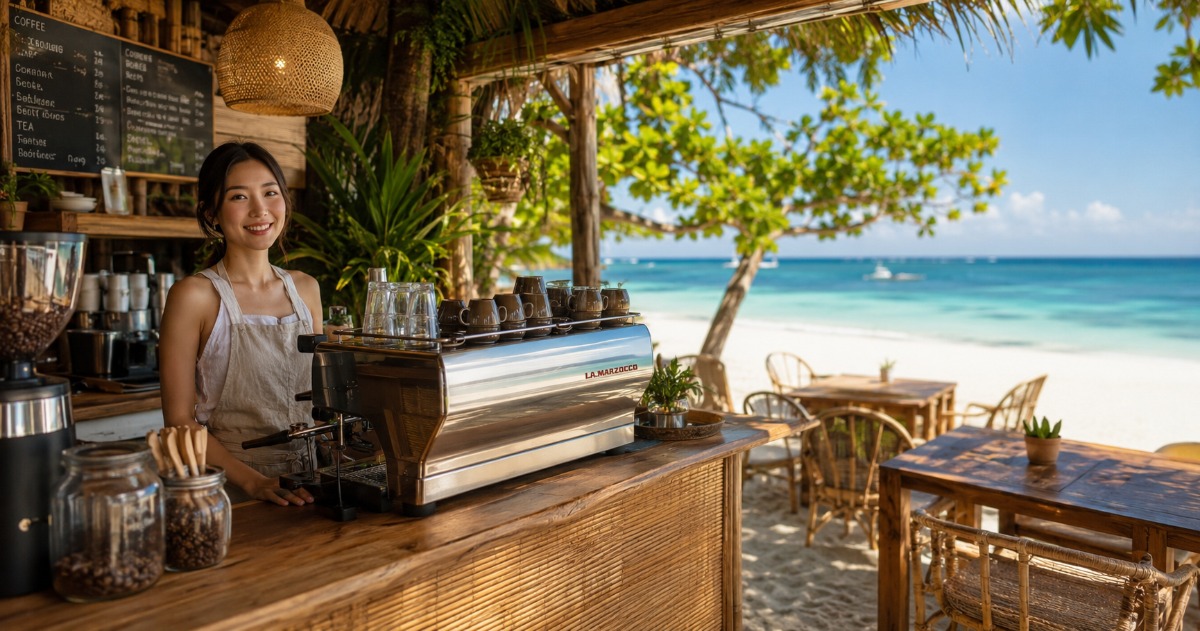
She had the playlist. She had the Notion doc with the mood board. She knew exactly what the cups would look like, what the music would sound like in the late afternoon, and how the light would fall through the window. What she did not have was 150 million won and the stomach for Gangnam rent.
This is a story for her.
Every year, thousands of Korean women in their 30s and 40s quietly do the math on the coffee shop dream and decide it does not add up. The cost to open a modest, tasteful cafe in Seoul, particularly in the neighborhoods where quality and aesthetics are expected, can rival the budget of a small commercial enterprise in a Western city. The math is brutal. The risk is real. And so the dream goes back into the Notion doc and life continues.
But there is a place, roughly four hours from Incheon by air, where the math works. Where a cafe that would cost 100 million to 150 million won to open in Seoul can be launched for 3 to 6 million pesos, which converts to roughly 7 to 14 million Korean won. Where rent for a charming shopfront with an ocean view costs less than a studio in Mapo-gu. Where the lifestyle you imagined running alongside your espresso machine is not a fantasy but simply Tuesday.
That place is Panglao, Bohol. And this is your practical guide to getting there.
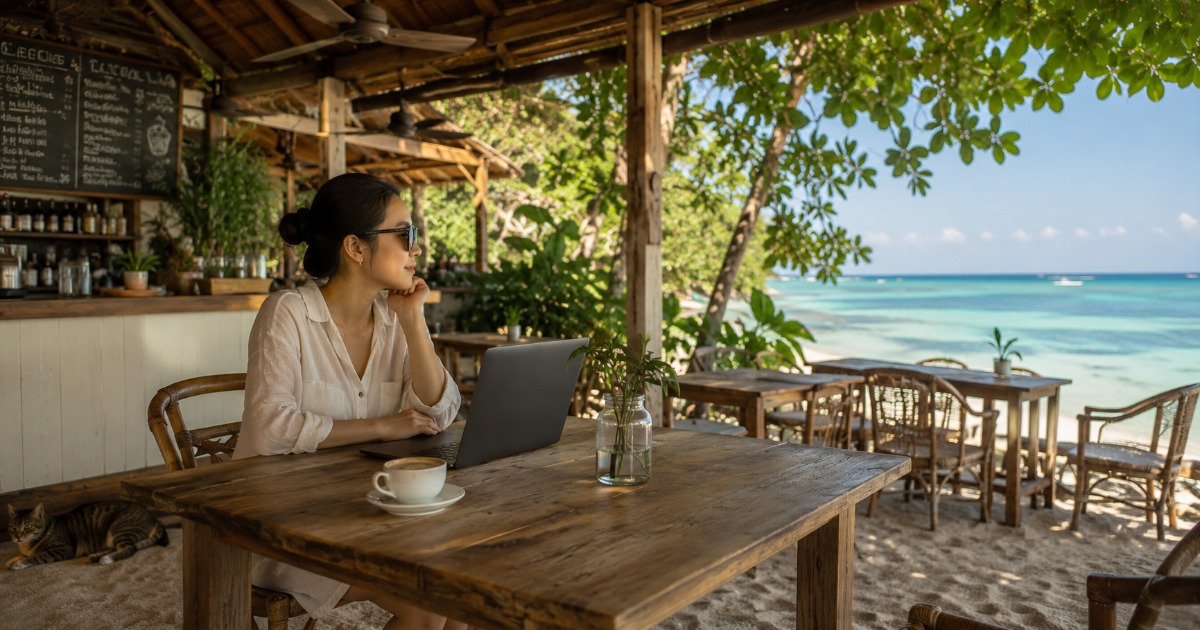
Panglao, Bohol: where the cafe lifestyle you imagined is simply Tuesday.
The Numbers That Change Everything
Before we talk about permits, visas, and espresso machines, let us talk about the number that changes the entire conversation: startup cost. Because the gap between Seoul and Panglao is not a small discount. It is a completely different financial universe.
Read those numbers again. The monthly rent on a 40-square-meter beachside shopfront in Panglao, with a covered terrace overlooking the water, is roughly what a Seoul landlord will ask for a security deposit deposit on a basement unit in Mapo-gu.
I have talked to Korean women who had 80 million won saved and thought they could not afford their dream. In Bohol, that same amount does not just open a cafe. It opens a cafe, pays rent for three years, and still leaves a runway. The psychology of that changes everything.
Why Panglao Specifically
Bohol has several towns worth considering for a lifestyle business, but Panglao stands apart for a specific combination of reasons that matter to the Korean entrepreneur-in-waiting.
There is also a growing network of Korean residents already in Bohol, particularly in Panglao and Tagbilaran. This matters more than it might seem. When you arrive, you will not arrive alone into an unfamiliar culture. You will find people who share your language, who know which contractor to trust, who have already navigated the permit process, and who would genuinely like a good cup of coffee made by someone who understands what that means.
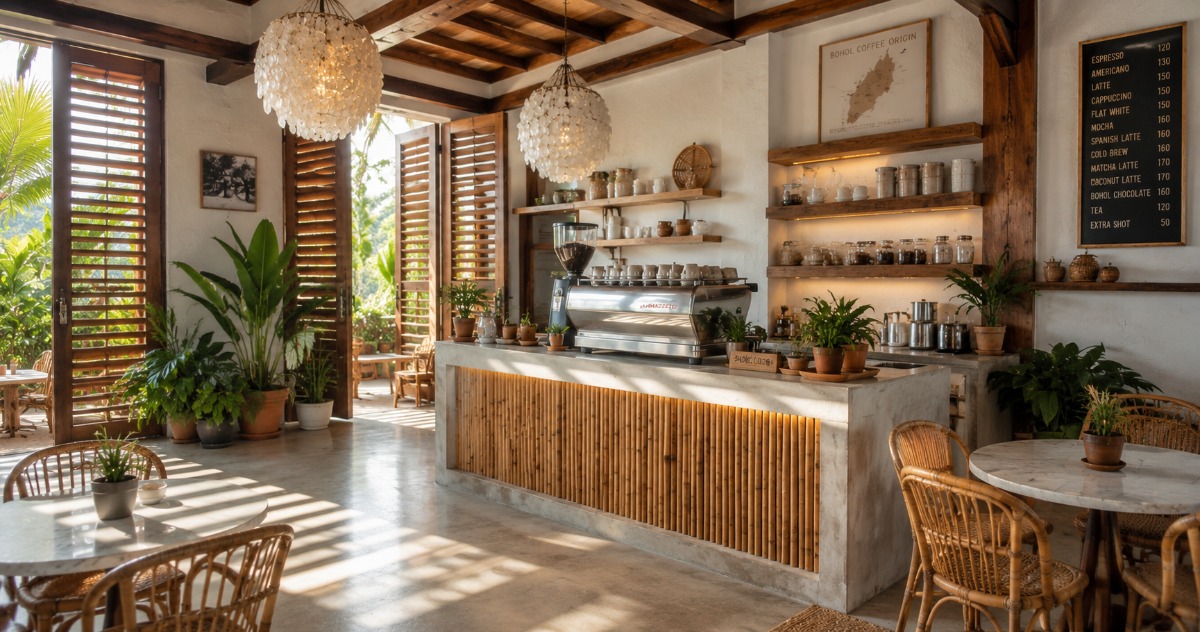
Local contractors in Bohol can produce beautiful, Instagram-worthy cafe interiors at a fraction of Seoul build-out costs.
What the Business Actually Looks Like
Let us be specific, because specificity is what separates a dream from a plan.
A typical small lifestyle cafe in Panglao, the kind a solo Korean woman entrepreneur might open and run with two local staff, would look something like this: 50 to 70 square meters of indoor and covered terrace space, a La Marzocco Linea or equivalent two-group machine, a quality grinder, a cupping bar, perhaps eight to twelve tables, and a menu focused on specialty coffee, a handful of pastries, and one or two light meal items.
Revenue from a cafe like this, in a tourist-visible location near Alona Beach or Anda Road, typically runs between 80,000 and 200,000 pesos monthly, depending on season and your own marketing investment. Monthly operating expenses, including rent, staff wages paid above market rate, coffee beans (which you can source locally from Benguet or import from Korean roasters via Manila), utilities, and consumables, will land between 45,000 and 90,000 pesos.
That is a sustainable, profitable lifestyle business. Not a get-rich scheme. A life.
The women I work with are not trying to build a chain. They want ownership. They want to wake up in a place they love, make something beautiful, and build a life that does not run on someone else’s calendar. Bohol lets them do exactly that.
The Legal Landscape: What Koreans Need to Know
Here is where many otherwise ready entrepreneurs get stuck, and where working with someone who knows the landscape saves not just money but months of confusion.
The Philippine Foreign Investment Act restricts 100% foreign ownership in retail trade below a certain capital threshold. This is the one piece of the puzzle that requires navigation rather than simply filling out forms.
Important note: Philippine law as of this writing requires foreign retail businesses to have a minimum paid-up capital of USD 200,000 (approximately 11.5 million pesos) if 100% foreign-owned. For smaller cafes, the most common legal structure used by foreign entrepreneurs is a partnership or corporation with a Filipino national holding at least 40% of shares. This is not a barrier. It is simply a structural step that requires a trustworthy local partner or shareholder and proper legal documentation. Always consult a licensed Philippine attorney before structuring your business.
The practical path most expat cafe owners in Bohol use involves registering a domestic corporation, bringing in a trusted Filipino partner for the required equity share, and structuring a shareholder agreement that protects the foreign investor’s operational control and profit distribution. Done correctly and with honest partners, this arrangement works smoothly and is legally sound.
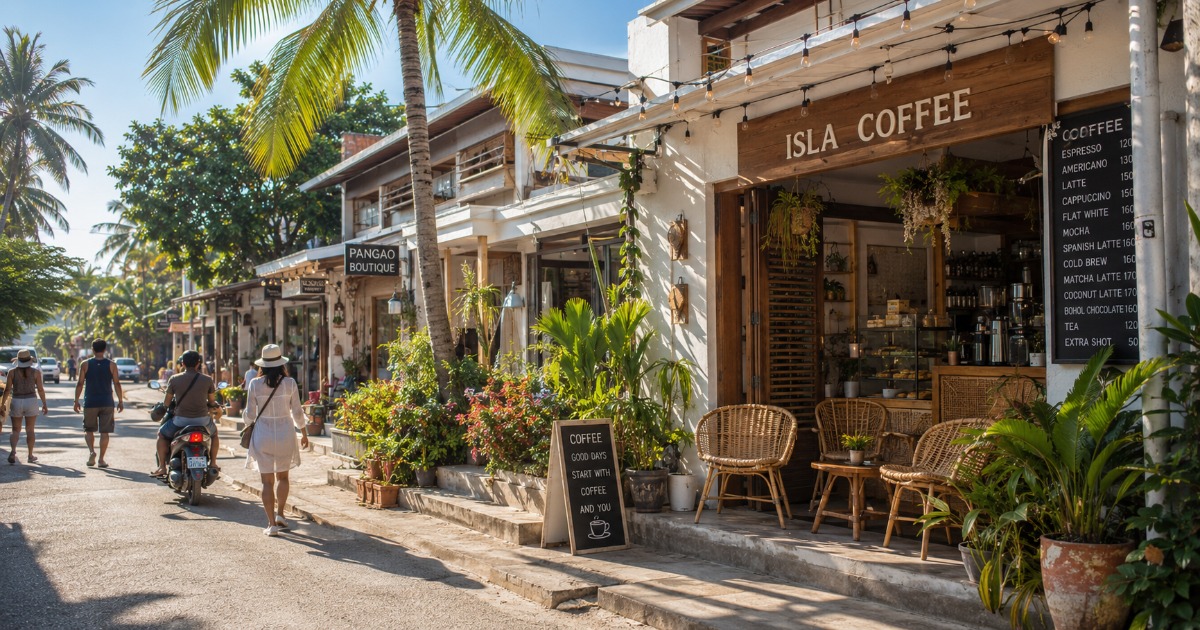
Commercial shopfronts along Panglao’s main tourist corridors offer prime cafe locations at a fraction of comparable spaces in Korea.
Your Step-by-Step Roadmap
What to Bring. What to Leave Behind.
- Barista certification or equivalent experience
- USD 25,000–50,000 startup capital
- Valid Korean passport (5+ years remaining)
- 6-month scouting trip mindset
- Willingness to hire and train local staff
- Reliable Philippine-based legal counsel
- Strong Instagram/social media presence
- Patience with Philippine bureaucracy timelines
Leave behind: the expectation that things will move at Seoul speed. The Philippines operates on a different tempo. Permits take longer than they should. Contractors run on island time. Utilities can be unreliable. These are real frustrations that every expat business owner will name if you ask them honestly.
But then ask those same people whether they would go back, and the answer is almost always no.
The women who succeed here are the ones who stopped waiting for the perfect moment and started asking the practical questions. Once you see the actual numbers, the conversation changes very quickly.
A Final Word on the Real Cost
There is one cost this article cannot calculate for you, and it is the only one that genuinely matters.
The cost of another decade of planning and not doing. Of watching the Notion doc accumulate pages while the lease renewal in Mapo-gu goes up again. Of reading articles like this one and clicking away.
The coffee shop dream has a shelf life. Not because passion expires, but because life has a way of adding obligations, complicating the math, and making the leap feel incrementally more impossible with each year it is deferred.
In Panglao, right now, there are Korean-owned cafes with beautifully curated playlists, afternoon light falling through hand-selected curtains, and owners who made the call. They were not uniquely brave. They were simply the ones who asked what it would actually cost.
Now you know.
Talk to a Move2Bohol Specialist
Lerma Moore and the Move2Bohol team help Korean entrepreneurs navigate every step, from your first scouting visit to your soft-opening day. No commission. No pressure. Just honest, practical guidance.
Start the Conversation