


Escaping Burnout Culture Without Losing Your Identity
Karoshi. The 996 grind. Two of the most demanding work cultures on earth are quietly producing a wave of exhausted professionals looking for an exit. Bohol may be the answer they didn’t expect.
There is a word in the Japanese language that has no adequate translation in English, because no other culture has felt the need to name what it describes quite so precisely. The word is karoshi — 過動死 — and it means death from overwork. It entered the national lexicon in the 1970s when a string of heart attacks and strokes among otherwise healthy young professionals began to be traced back to the same root cause: too many hours, too much pressure, and a culture that had elevated the sacrificing of one’s body in service of a company into something resembling a civic virtue. More than half a century later, it is still happening. A 2025 survey found that roughly one in ten Japanese workers logs more than 80 hours of overtime each month — a threshold that researchers have directly linked to serious cardiac and neurological risk.
South Korea has its own version. They call it gwarosa, and the numbers are similarly unsettling. Korean workers routinely rank among the most hours-worked in the OECD. The chaebol system — the web of massive family-owned conglomerates that dominates the Korean economy — has long enforced a culture where presence is performance and leaving before your senior is a form of social insubordination. China’s “996” schedule (9am to 9pm, six days a week) may have the more internationally recognizable name, but the Korean version of the same phenomenon has been grinding through workers for just as long and just as quietly.
Something is shifting, though. Younger Japanese workers — particularly men in their 20s — are logging measurably fewer hours than any previous generation since the turn of the century. Annual working hours in Japan dropped more than 11 percent between 2000 and 2022. “Young people are deciding that they do not want to sacrifice themselves for a company,” one Japanese media professor told the South China Morning Post. In South Korea, a similar quiet rebellion has been building, with younger professionals increasingly exploring what a life beyond the office might look like — and increasingly, they are looking south. Toward the tropics. Toward Bohol.
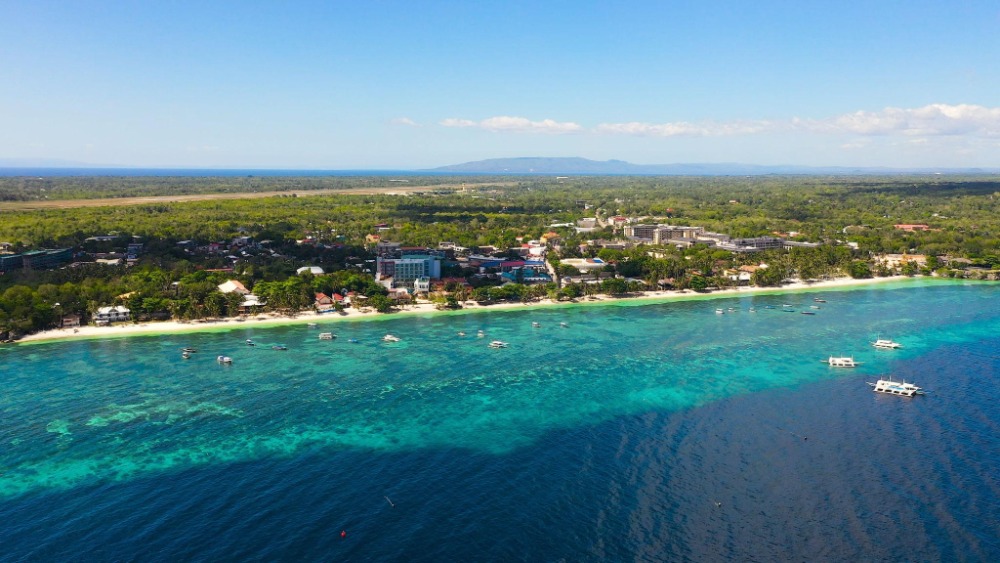
Before getting into the practical questions — language, visas, cost of living, community — it is worth establishing what Bohol is, because many Japanese and Korean readers may know the name without knowing the island. Bohol sits in the Visayan Sea in the central Philippines, roughly two hours by flight from Tokyo or Seoul (connecting through Manila or Cebu). It is not large — about 4,117 square kilometers — but it is one of the most geologically, ecologically, and culturally distinct places in Asia.

The Chocolate Hills — more than 1,200 almost perfectly symmetrical conical mounds that turn brown in the dry season — are the most photographed, but they are only the beginning. Bohol has some of the Philippines’ finest white-sand beaches on Panglao Island, world-class dive sites in the Bohol Sea, the Philippine Tarsier Sanctuary (home to the world’s smallest primate), and Baclayon Church, one of the oldest stone churches in the country, built in the late 1500s. In 2025, Bohol was recognized by the Philippines’ own tourism authorities as the nation’s Best Tourism Destination Province among all 82 provinces. It is also the country’s only UNESCO Global Geopark — a designation that places it alongside places like Iceland’s Golden Circle, Japan’s Oki Islands, and Korea’s Jeju Island on the map of the world’s most significant natural heritage destinations.
Bohol welcomed 1,427,362 tourists in 2025 — a 4.18 percent increase over the prior year — with foreign arrivals growing nearly 15 percent. South Korea is already the island’s dominant international source market. Charter flights from Japan are beginning in May 2026, specifically targeting the kind of high-value, culturally aligned traveler that Move 2 Bohol has been speaking to for years. The island is not undiscovered. But it is not yet crowded. And it is still, by the standards of comparable destinations in Asia, strikingly affordable.
“Bohol has this remarkable quality of feeling remote and peaceful, but it is not actually isolated. You are two hours from a major international hub, you have reliable connectivity, and you have a community that already knows how to welcome Japanese and Korean visitors. The infrastructure is here. What people are finding is that the life is also here.”
— Lerma Moore, Move 2 Bohol Property SolutionsOne of the most persistent fears among Japanese and Korean professionals considering a move abroad is the loss of cultural grounding — the sense that leaving means becoming unmoored, that comfort and familiarity are things only available at home. Bohol challenges that assumption in ways that are both practical and surprisingly emotional.
The Filipino-Korean cultural affinity is well-documented and genuinely deep. Researchers have pointed to striking parallels: both cultures are built around hospitality, family loyalty, and a social sensitivity to the feelings of others. Both have strong food cultures that center on communal eating. Both carry colonial histories that created complex, layered national identities. The Korean Wave — Hallyu — did not become a phenomenon in the Philippines by accident; it landed so quickly because Filipinos recognized something familiar in it. Korean dramas, K-pop, Korean food — all of it found a deeply receptive audience here long before it went global. There are already tens of thousands of Koreans living in the Philippines, making it the second largest Korean diaspora community in Southeast Asia.
For Japanese visitors specifically, there is a philosophical resonance worth naming. The Japanese concept of ikigai — the intersection of what you love, what you are good at, what the world needs, and what you can be paid for — has become a global wellness reference point. But it is hard to find your ikigai when you are spending 80 hours a week on tasks assigned by someone else. Bohol, with its pace and its natural setting, offers something that urban Japanese life has quietly starved: the space to think. The time to feel. The chance to ask, without irony, what you actually want.
One of the most immediately practical questions any Japanese or Korean professional asks about living abroad is the language question. And here, the Philippines offers something genuinely unusual: English is a co-official language, used in government, education, media, business, and daily conversation across the country. In Bohol specifically, the local language is Cebuano (also called Bisaya), but English is spoken with ease and comfort at every level of daily life — from the market to the hospital to the government office.
For Japanese readers, this matters a great deal. Japan’s English proficiency, while improving, remains a significant practical barrier for many professionals considering life abroad. In Bohol, you do not need to learn Tagalog. You do not need to learn Cebuano. A functional, conversational English — the kind that many Japanese and Korean professionals already have from school and business — is entirely sufficient for daily life, medical appointments, property transactions, and community engagement. This is not true of most Southeast Asian countries, where the local language gap can be a genuine barrier to integration.
- 80+ hour work weeks with no visible ceiling
- Social pressure to stay late, always
- Tiny, expensive apartments in dense cities
- Summers of humidity without the ocean
- The hierarchy of senpai-kohai that never fully lifts
- Commutes measured in hours, not minutes
- Karoshi / gwarosa as a recognized occupational risk
- Cost of living that consumes 60-80% of income
- Your own schedule, built around your priorities
- A community that greets you, not evaluates you
- Affordable housing near the ocean
- Year-round warm weather, minutes from white-sand beaches
- A flat, friendly social culture with no rigid hierarchy
- Everything accessible within a 20-minute drive
- A UNESCO Geopark, wildlife sanctuary, and dive sites at your door
- Comfortable living from $1,000–1,400 per month
“Language is the first thing people worry about, and it always turns out to be the last thing they actually struggle with. Bohol is an English-friendly island. You will manage your banking, your doctor visits, your property questions, and your friendships in English. The local people here are not only capable in English — they are warm about it. They enjoy talking to you.”
— Lerma Moore, Move 2 Bohol Property SolutionsBoth Japanese and South Korean nationals receive 30-day visa-free entry to the Philippines — an immediate, frictionless way to arrive, explore, and test the island before committing to anything. From that initial landing, the Philippines offers one of the most flexible and forgiving extension systems in Southeast Asia: tourist visas can be extended incrementally up to a maximum of 36 months through straightforward Bureau of Immigration visits, without requiring any formal long-term visa commitment during that period.
For those ready to commit to longer-term or permanent residence, the Philippines restructured its flagship retirement program in September 2025, creating a revised Special Resident Retiree’s Visa (SRRV) with updated requirements. The minimum age was lowered to 40, making it accessible to a significant portion of mid-career professionals who have already reached burnout and are ready for a genuine change rather than a sabbatical. The Philippines also launched a formal Digital Nomad Visa in 2025 for remote workers, requiring proof of at least $24,000 in annual remote income — a threshold comfortably met by many Japanese and Korean professionals working remotely for home-country employers.
| Visa Option | Who It’s For | Duration | Key Requirement |
|---|---|---|---|
| Tourist Visa (Free Entry) | First-time visitors; testing the island | 30 days (extendable to 36 months) | Valid passport; no application required |
| Digital Nomad Visa (DNV) | Remote workers employed abroad | 12 months, renewable once (24 months total) | $24,000/yr remote income; health insurance; foreign employer |
| SRRV Classic (Age 50+) | Retirees; semi-retired professionals | Indefinite stay; multiple entry | $15,000 deposit (with pension) or $30,000 (without) |
| SRRV Classic (Age 40–49) | Mid-career professionals, early retirees | Indefinite stay; multiple entry | $50,000 deposit; min. age 40; health clearance |
| 13(a) Spouse Visa | Those married to Filipino citizens | Permanent (after 1-year probationary) | Marriage to Philippine citizen; supporting documents |
SRRV holders benefit from indefinite stay with multiple-entry privileges, exemption from certain Philippine taxes on foreign-sourced income, customs duty exemptions on personal effects, and the ability to bring dependents under the same program. For a Japanese or Korean professional arriving with retirement savings and a pension, the SRRV is one of the most genuinely favorable long-term residency programs in Asia. The deposit is refundable if the visa is surrendered — meaning it functions less like a fee and more like a held investment.
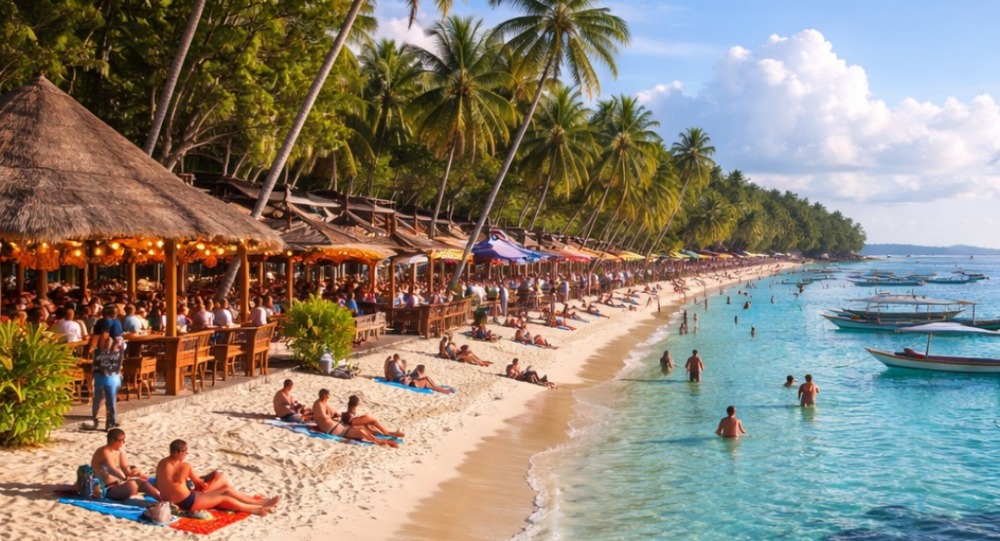
The cost-of-living question is where abstract aspiration meets practical arithmetic, and Bohol performs well on both counts. A single professional living comfortably in Bohol — a well-furnished rental near the water, dining out regularly, maintaining transportation, and covering utilities — can expect to spend somewhere in the range of $1,000 to $1,400 per month. That figure represents a lifestyle that in Tokyo would cost three to four times as much, and in Seoul, at least double.
For Japanese readers, a useful comparison: a modest one-room apartment in Tokyo’s 23 wards now commonly rents for ¥80,000–120,000 per month — for a space where you may not be able to extend your arms in all directions simultaneously. In Bohol, the same monthly outlay rents a home with outdoor space, garden access, and possibly an ocean view. The calculation is not subtle.
Korean readers may find the food transition particularly smooth. Filipino cuisine shares rice as its foundation, uses abundant fresh fish and seafood, leans toward salty and savory flavor profiles, and centers on the table as a social gathering point. Korean grocery items — from ramyeon to gochujang — are increasingly available in Tagbilaran’s growing supermarkets. The Korean community already living in Bohol and surrounding Panglao has created the kind of informal support network that makes the practical adjustment far easier than arriving somewhere with no cultural foothold.
There is a harder question underneath all the practical ones, and it deserves a direct answer. For Japanese and Korean professionals in particular — people from cultures where work identity and personal identity are deeply interwoven — the prospect of stepping away from the career system raises something that is not just logistical but existential. Who am I, if I am not working at the pace I was trained to work?
The honest answer from the people who have made this move is that the question dissolves faster than expected — not because Bohol erases your identity, but because it gives you enough quiet to find out what was underneath it. The morning beach walk. The coffee before the emails. The conversation that doesn’t end because a meeting is starting. These are not small things. For people who have spent years in environments where their internal life was subordinated to their professional schedule, they are the beginning of something new.
Bohol’s pace is not the pace of retirement. It is the pace of intention. There is a growing remote-work community on the island. There are people building businesses, writing books, consulting internationally, creating things, and resting with purpose. The island is not asking you to give up ambition. It is asking you to aim it at something that matters to you personally — rather than at the quarterly targets of a company that will replace you the week after you collapse.
Japanese and Korean professionals considering Bohol are not fleeing their identities. They are, in many cases, returning to them. The island happens to be a very good place to do that.
You do not need to decide everything today. The Philippines lets you arrive on your passport, stay for a month, and see what you think. That is a low-cost experiment with a potentially life-changing result. Bohol is about two hours away. The ocean is warm. The Chocolate Hills are exactly as strange and beautiful as the photos suggest. And the island is not asking anything of you except your honest attention.
That is quite different from what your current employer is asking.